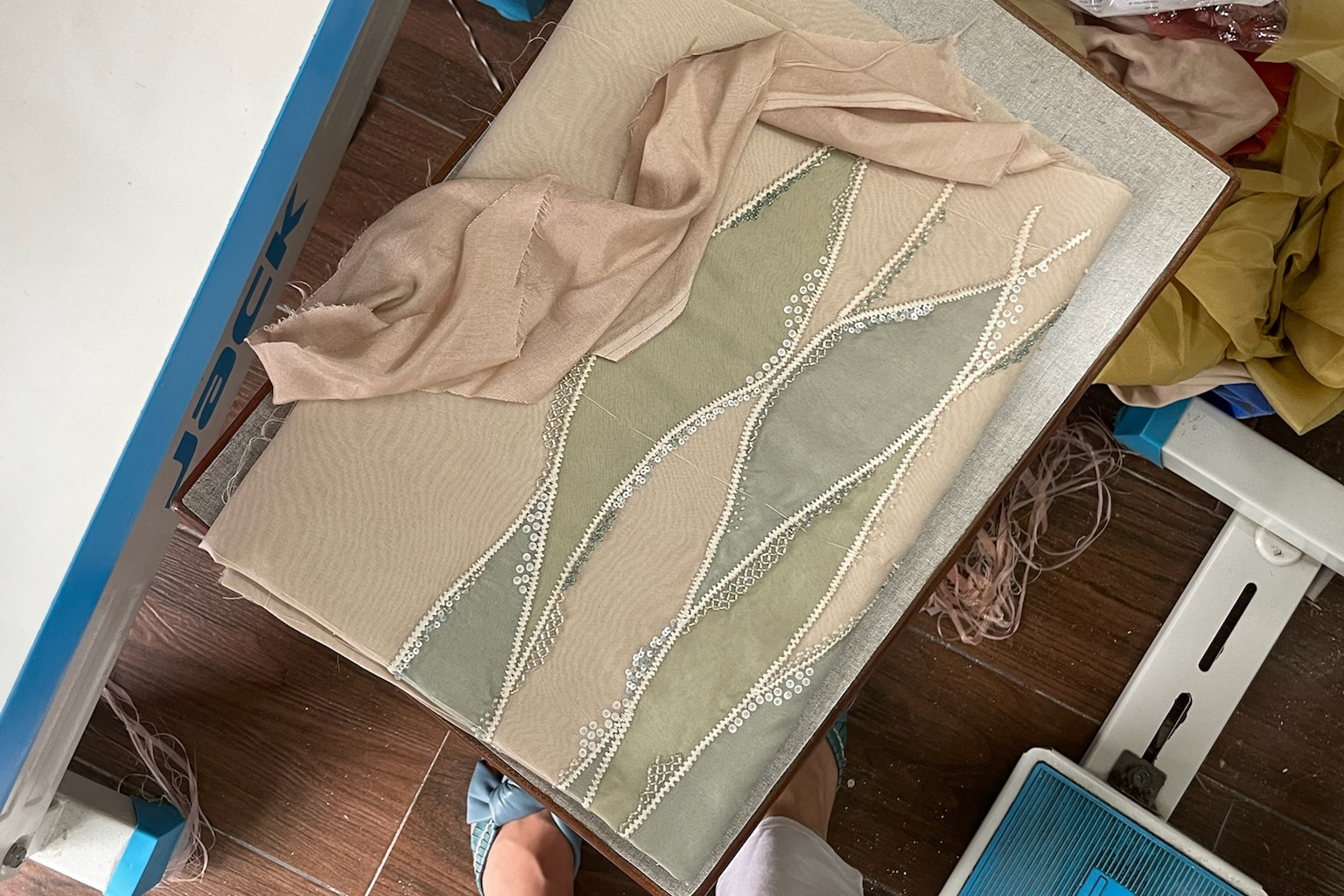

Article: The Difference Between Handmade, Handcrafted, and Handmade-Inspired Fashion
The Difference Between Handmade, Handcrafted, and Handmade-Inspired Fashion
Fashion has always had a vocabulary problem. Words that once meant something specific — artisan, craft, heritage, handmade — have been borrowed, stretched, and repositioned until they risk meaning everything and nothing at once. Walk through any mid-market retailer today and you will find labels that evoke workshops and weavers, skilled hands and slow process, even on garments that have never been touched by anything other than an automated loom.
This is not always deliberate deception. Sometimes it is the natural drift of language in a competitive market. But the effect on the consumer is the same: genuine difficulty in knowing what she is actually buying.
The purpose of this piece is not to indict any label or expose any particular practice. It is to draw clear lines between three terms that appear constantly in fashion marketing — handmade, handcrafted, and handmade-inspired — and to give readers the tools to evaluate what those words mean when they encounter them. Knowledge, in this context, is the most useful thing a brand can offer.
Handmade: The Most Precise Term
Of the three, handmade is the most specific — and therefore the most frequently misapplied.
A handmade garment is one in which the primary construction has been carried out by human hands, without the use of industrial machinery. This means the fabric was cut by hand, the pieces assembled by hand, and the finishing completed by hand. A truly handmade garment requires no powered sewing machine, no automated cutting table, no mechanised process of any kind.
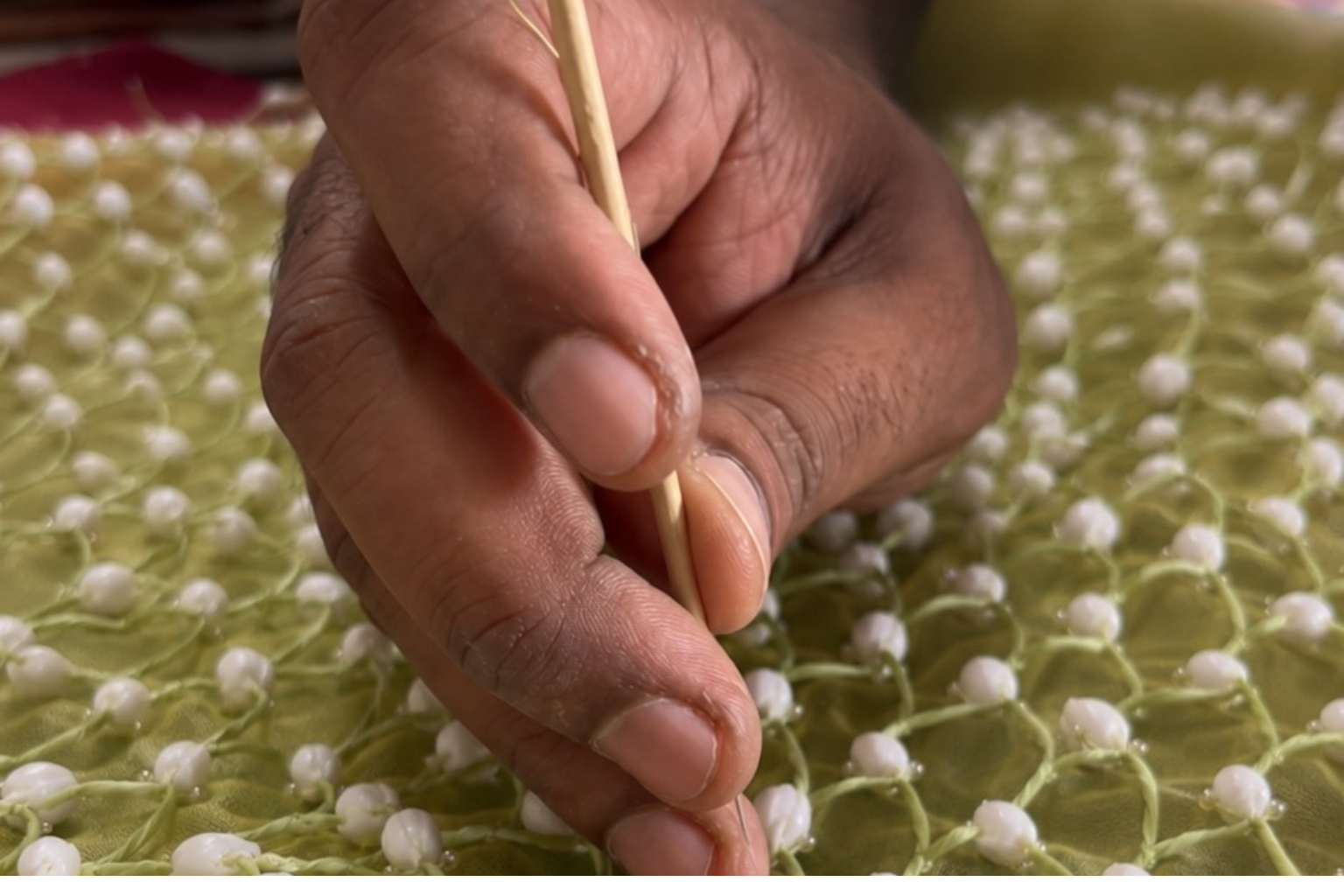
In practice, pure handmade clothing is rare and specific. It belongs to the world of the master tailor working from a personal commission, the village weaver producing cloth on a traditional handloom, the artisan creating a single ceremonial piece. Hand-stitched buttonholes on a bespoke suit. A hand-knotted textile produced over months. Embroidery completed entirely by needle and thread without the assistance of an embroidery machine.
What handmade is not: a garment sewn on a domestic sewing machine in a home studio, though it is common to find this described as handmade. Nor is it a garment assembled in a small factory using industrial equipment, even if the factory employs fewer than a dozen people. The presence of human beings in a production process does not make the resulting garment handmade. Almost every garment, including those made at the largest scale, involves human hands at some point.
The key question with any handmade claim is simple: which parts of this garment were made entirely without powered machinery, and how significant are those parts to the whole?
Handcrafted: Skill Over Strict Process
Handcrafted is a broader and, honestly, more honest term for most of what the artisanal fashion world produces.
A handcrafted garment is one in which skilled human judgement, technique, and attention have been central to the making — even where tools and machinery assist in parts of the process. The distinction from mass production lies not in the complete absence of equipment, but in the irreplaceable role of the craftsperson's expertise at every significant stage.
Consider a jacket made in a small atelier. The fabric may have been cut using sharp shears guided by a hand-drafted pattern — or it may have been cut on a machine, directed by a skilled cutter who understands how to work with that particular cloth. The seams are stitched on a sewing machine, but by a tailor whose technique produces results that an unskilled operator on the same machine could not replicate. The finishing — the hand-sewn lining, the carefully pressed lapel, the buttonholes worked by a specialist — is done entirely by hand.
This jacket is handcrafted. It is not handmade in the strictest sense. But it carries the mark of human skill throughout, and that skill is what gives it its quality, its character, and its longevity.
Handcrafted artisanal garments represent the majority of what genuine slow fashion produces: pieces where human expertise is non-negotiable, where the craftsperson's knowledge shapes the outcome at every stage, and where no two pieces are entirely identical because the human element ensures they cannot be.
This is also the category to which most quality craftsmanship in fashion belongs — and the term that, used honestly, tells a reader something real about how a garment was made.
Handcrafted is a broader and, honestly, more honest term for most of what the artisanal fashion world produces.
A handcrafted garment is one in which skilled human judgement, technique, and attention have been central to the making — even where tools and machinery assist in parts of the process. The distinction from mass production lies not in the complete absence of equipment, but in the irreplaceable role of the craftsperson's expertise at every significant stage.
Consider a jacket made in a small atelier. The fabric may have been cut using sharp shears guided by a hand-drafted pattern — or it may have been cut on a machine, directed by a skilled cutter who understands how to work with that particular cloth. The seams are stitched on a sewing machine, but by a tailor whose technique produces results that an unskilled operator on the same machine could not replicate. The finishing — the hand-sewn lining, the carefully pressed lapel, the buttonholes worked by a specialist — is done entirely by hand.
This jacket is handcrafted. It is not handmade in the strictest sense. But it carries the mark of human skill throughout, and that skill is what gives it its quality, its character, and its longevity.
Handcrafted artisanal garments represent the majority of what genuine slow fashion produces: pieces where human expertise is non-negotiable, where the craftsperson's knowledge shapes the outcome at every stage, and where no two pieces are entirely identical because the human element ensures they cannot be.
This is also the category to which most quality craftsmanship in fashion belongs — and the term that, used honestly, tells a reader something real about how a garment was made.
Handmade-Inspired: Aesthetic Without Origin
Handmade-inspired is a different category altogether, and the most important one for consumers to understand.
A handmade-inspired garment is one that borrows the visual language of handmade or handcrafted clothing — irregular textures, artisanal-looking prints, embroidery-effect patterns, woven-looking surfaces — but is produced through entirely industrial means. The "hand-painted" print was digitally designed and machine-applied. The "artisan weave" is a mass-produced jacquard. The embroidered border was produced on a computerised embroidery machine running hundreds of identical pieces per day.
None of this is inherently dishonest when the term inspired is doing its proper work — signalling an aesthetic reference rather than a production method. The problem arises when handmade-inspired garments are described simply as handmade or artisan, or when the aesthetic cues of craft are used to imply a quality of making that the garment does not possess.
A textured surface can be produced by a machine in seconds or by a weaver over days. The visual result may be similar. The durability, the character, and the relationship between the garment and its maker are entirely different. Understanding which category a garment belongs to allows a consumer to evaluate it on the right terms — not to dismiss the handmade-inspired category, but to engage with it accurately.
Comparison at a Glance
| Handmade | Handcrafted | Handmade-Inspired | |
|---|---|---|---|
| Primary construction | Entirely by hand, no powered machinery | Skilled human process, tools and machines may assist | Industrial machinery throughout |
| Role of the artisan | Sole creator of the garment | Central decision-maker at every stage | Designer of the aesthetic reference |
| Consistency between pieces | Naturally variable | Subtly variable | Highly consistent |
| Production volume | Very low | Low to moderate | High |
| Price point | Highest | Premium | Varied |
| What you are buying | Pure human labour and skill | Expertise, judgement, and craft tradition | An aesthetic reference to craft |
Common Misconceptions Worth Addressing
"Small batch means handmade." Not necessarily. A brand producing fifty units of a style rather than five thousand is making a considered decision about volume — and that decision often reflects a genuine commitment to quality. But the production method may still involve industrial sewing machines, automated cutting, and factory finishing. Small batch is a meaningful quality signal. It is not synonymous with handmade.
"If a person made it, it's handmade." This is the most persistent misconception. Every garment involves human beings — threading machines, loading fabric, overseeing production. The handmade designation refers to a specific method of making, not merely to the presence of people in the process.
"Handcrafted means inconsistent." The opposite is often true at the highest levels of skill. An experienced craftsperson produces remarkably consistent results — not through mechanical uniformity, but through the developed precision that comes with years of practice. The variability in handcrafted work is subtle, and it is the evidence of individual attention, not of carelessness.
"Handmade-inspired is inferior." Not categorically. A beautifully designed machine-made garment in quality fabric, cut with care and finished well, can be an excellent piece of clothing. The issue is only when its production method is obscured by language that implies something different. On its own terms, handmade-inspired can be entirely worthwhile.
What to Look For When You're Evaluating a Garment
Language in marketing is a starting point, not a conclusion. Here are more reliable signals to look for when assessing whether a garment reflects genuine quality craftsmanship.
Ask about the process. A brand confident in its making will describe it specifically. Not "lovingly crafted by skilled artisans" but where, by whom, using which techniques. Vagueness in this area is informative.
Look at the finishing. Turn the garment inside out. The interior of a well-made piece is almost as considered as its exterior — clean seam allowances, properly finished edges, a lining that lies flat and is attached with care. Industrial shortcuts show most clearly here.
Examine the seams under tension. Gently pull the seam of a finished garment. Quality construction holds without distortion. Weak seams — common in high-volume production where speed takes priority — will reveal themselves quickly.
Check for the subtlety of variation. In genuinely handcrafted garments, look closely at repeating elements: the spacing of buttons, the line of a hem, the alignment of a print at a seam. Slight, confident variation suggests human hands. Perfect mechanical uniformity across every detail suggests otherwise.
Consider the weight and hand of the fabric. Handmade clothing and handcrafted fashion are rarely made in materials that feel insubstantial. The investment in making is typically matched by an investment in cloth. A garment that feels light in the hand in the wrong way — limp, synthetic, inexpressive — rarely improves under scrutiny.
Look for a maker's story. Not a brand story, which can be constructed around an aesthetic. A maker's story: the name of the weaver cooperative, the region where the embroidery tradition originates, the name of the atelier. These details are not decoration. They are evidence.
Choosing With Clarity
The goal here is not to make shopping more complicated, but to make it more honest — for the consumer and, by extension, for the industry.
When a woman buys a garment knowing exactly what it is — how it was made, by whom, with what level of skill and attention — she is in a position to decide whether it is right for her on accurate terms. She may choose a handmade-inspired piece for its design and its price point, and find it entirely satisfying. She may invest in a handcrafted garment for the quality that will serve her across a decade of wear. She may seek out truly handmade clothing for a specific occasion or a piece of particular significance.
None of these choices is wrong. All of them benefit from being made clearly, with language that carries its original meaning.
Slow fashion, at its most useful, is not a price bracket or an aesthetic. It is a practice of attention — to how things are made, what they are made of, and whether the story being told about them is the true one. That practice begins with words, and what we are willing to ask of them.