
Why Craftsmanship Can Never Be Mass Produced
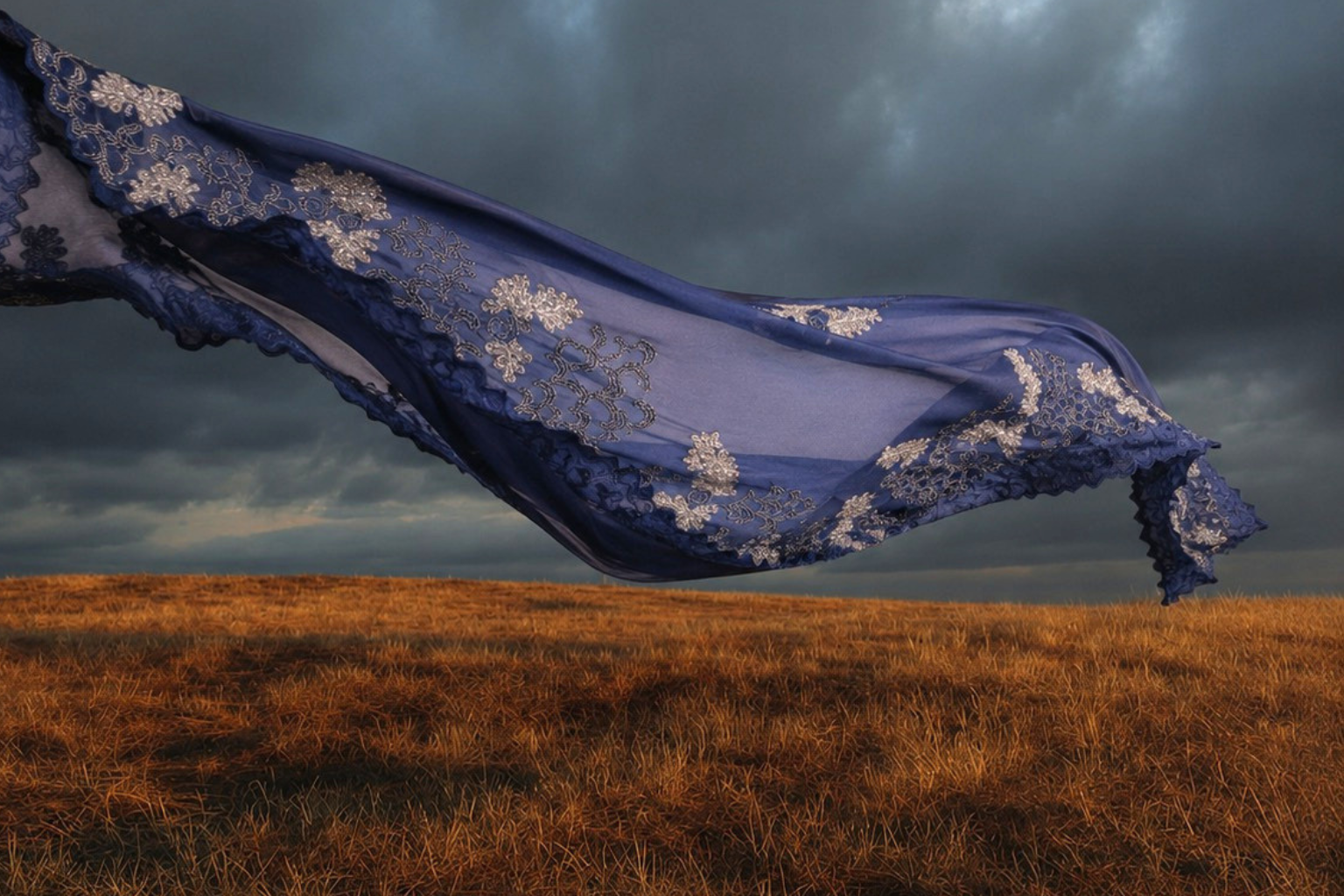
Look closely at a handwoven textile — close enough to follow a single thread across the cloth — and you will find the maker there. A tension that shifts almost imperceptibly from one edge to another. A rhythm in the weave that is uniquely human: steady but alive, precise but not mechanical. These are not flaws. They are signatures.
We live in an era that has become exceptionally good at removing such traces. Modern manufacturing can produce a thousand identical garments before a skilled artisan has finished one. Tolerances are measured in fractions of a millimetre. Consistency is the highest value. And yet, something that those thousand identical garments do not possess persists in that single handcrafted piece — a quality that is difficult to name but unmistakable in the wearing.
Craftsmanship is not a romantic idea. It is a technical reality. And understanding it — what it demands, what it produces, why it cannot be replicated at scale — changes the way one looks at a garment entirely.
The Difference Between Manufacturing and Making
Manufacturing is, at its core, a process of elimination. Every variable that can be removed from a production line is removed — variation in material, in timing, in the application of force or heat or pressure. The goal is a controlled output: identical units produced at maximum speed. This is not a criticism. For many things, it is exactly the right approach.
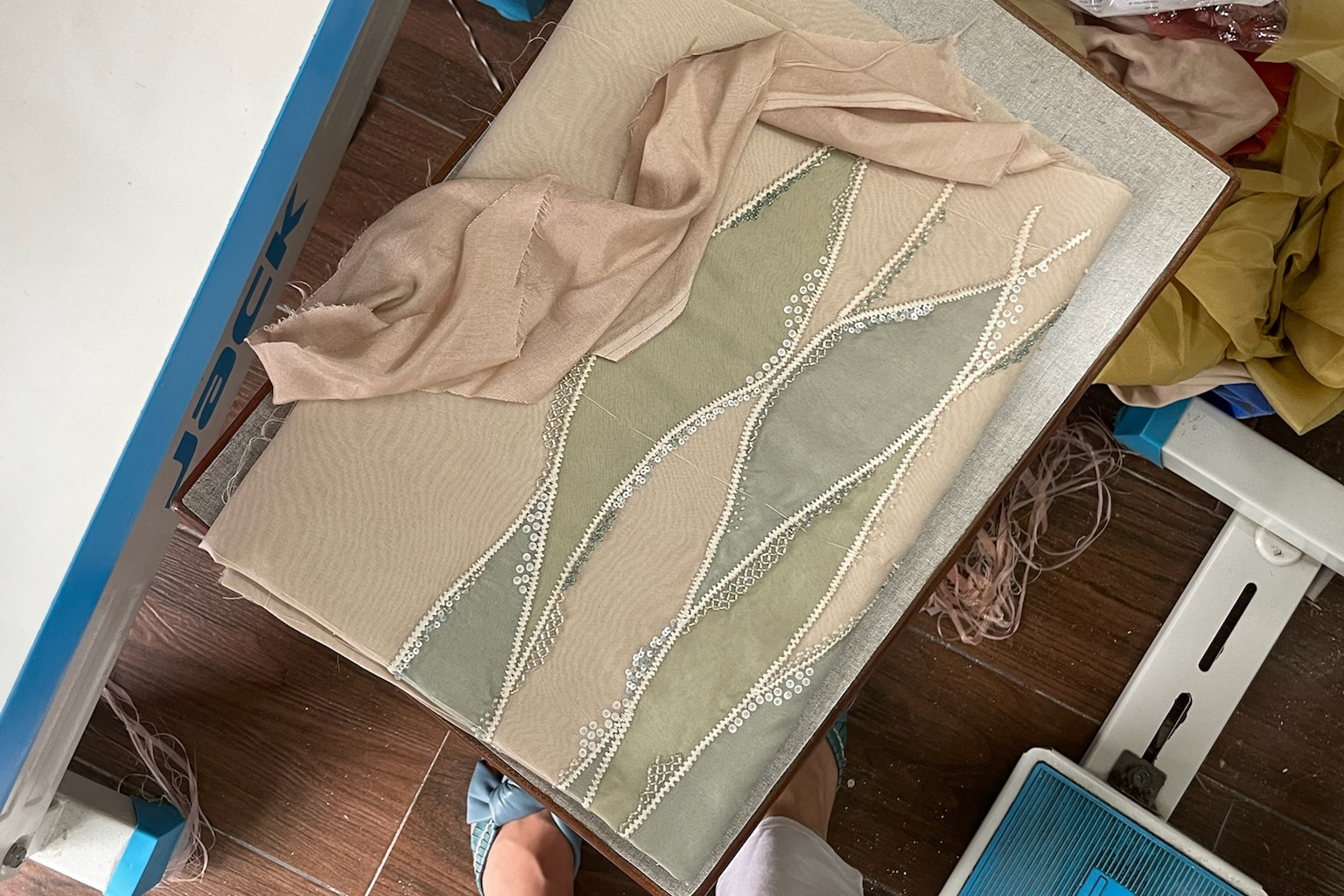
Garment-making, when it rises to the level of craftsmanship, is a different kind of process entirely. Rather than eliminating variables, a skilled artisan navigates them. Each piece of cloth behaves differently — even fabric cut from the same bolt can drape differently depending on the direction of the grain, the humidity in the room, the way it has been stored. A craftsperson reads these variations and responds to them. She adjusts the cut, eases the seam, works with the material's own nature rather than against it.
This is the fundamental distinction: manufacturing imposes a predetermined outcome on its materials. Craftsmanship is a conversation between the maker and the made.
The result is a garment that fits more naturally into the contours of a body, that moves with more intelligence, that ages with more grace. Not because the maker is infallible, but because she is present — making decisions at every stage that no automated system has yet been designed to make.
The Beauty in What Is Not Perfectly Uniform
There is a concept in Japanese aesthetics known as wabi-sabi — an appreciation for the beauty found in impermanence, incompleteness, and imperfection. It is the philosophy behind a tea bowl valued for its asymmetry, a textile treasured for the slight irregularity in its weave. Cultures that have maintained deep craft traditions have long understood something that industrial production obscures: that perfect uniformity is not the same as beauty.
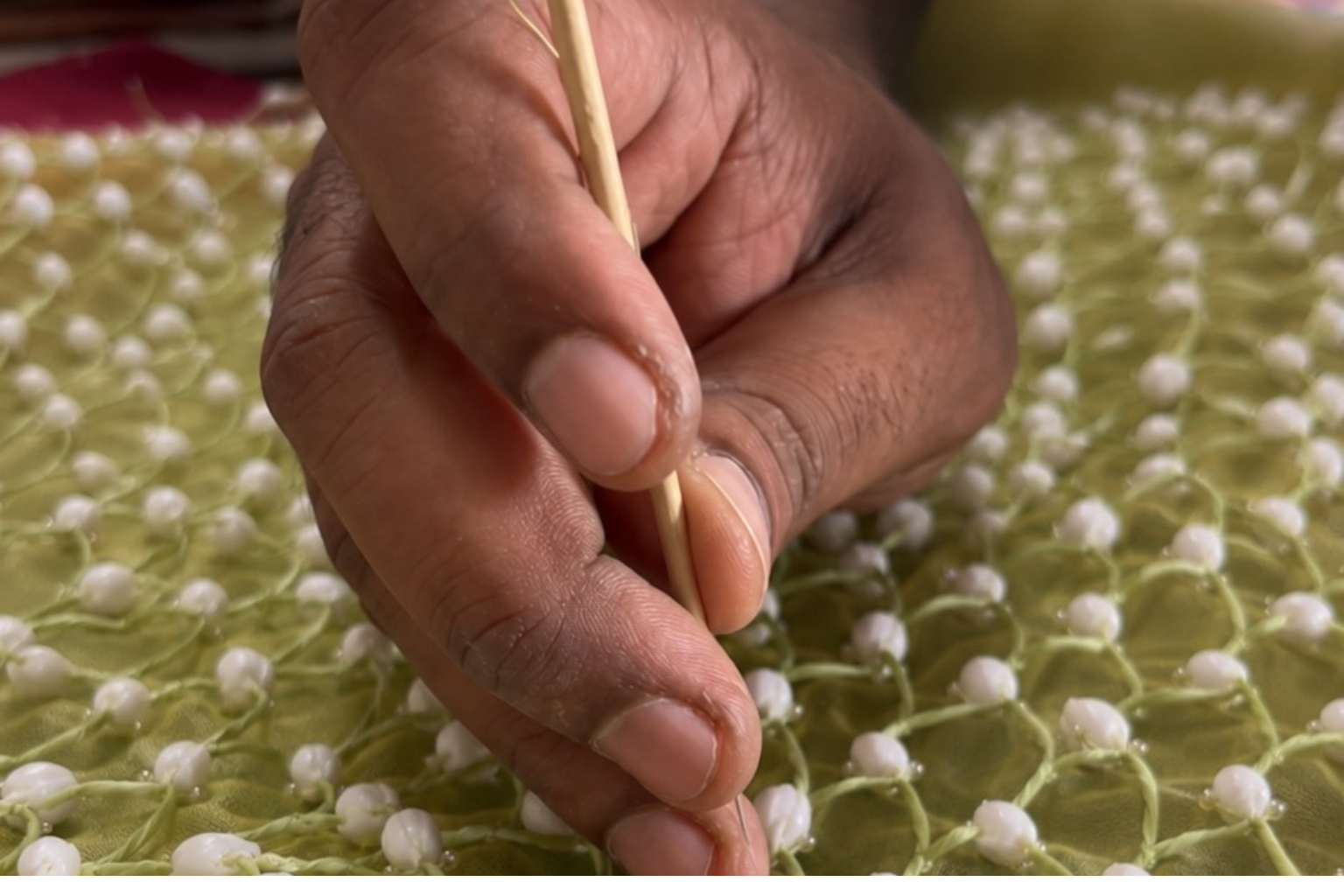
In handcrafted garments, the subtle variations produced by human hands are precisely what give them warmth. A hand-rolled hem carries the particular pressure of the person who rolled it. Hand embroidery holds the individual tension of each stitch. Block-printed fabric retains the ghost of the stamp at its edges — a soft boundary that no digital print can replicate, because digital prints do not breathe.
These qualities are not incidental. They are the physical evidence of a human being's attention. To wear a piece made this way is to wear something that has been genuinely considered — not processed.
This is not nostalgia for imperfection. It is a recognition that uniformity, pursued without limit, eventually produces objects that feel inert. The slight irregularity of artisan-made clothing is what makes it feel inhabited, even before it is worn.
Skill That Cannot Be Downloaded
There is a conversation in technology circles about the time it takes to achieve mastery — the famous ten thousand hours. What that framework captures, and also misses, is the nature of the knowledge being accumulated.
A master tailor does not simply know more than a novice. She knows differently. The knowledge is distributed across her hands, her eyes, her body — she feels when a seam is pulling before she sees it, reads the fall of cloth the way a musician hears a chord slightly out of tune. This is what researchers call tacit knowledge: expertise so deeply embedded in practice that it cannot be fully articulated, only demonstrated.
Artisanal clothing is built on this kind of knowledge. A fabric cutter who has spent fifteen years working with silk understands how it will behave on the bias, how much ease to build into a curve, how it responds to different weights of interfacing. That understanding is not in any manual. It was built, hour by hour, through the specific friction of material and hand.
No machine yet built possesses this. Artificial intelligence can pattern-match from existing data; it cannot develop intuition. Automation can reproduce a known output; it cannot make the judgment call that a particular cloth, on this particular day, needs to be handled differently. Craftsmanship, in this sense, is always at the edge of what is known — the artisan continuously making small decisions that lie beyond the range of any algorithm.
When Consistency Becomes a Ceiling
There is a paradox at the heart of industrial production: the very thing it optimises for — consistency — can become the limit of what it achieves.
Consistency ensures that every unit meets a defined standard. It guarantees the floor. But it also, by definition, prevents anything from exceeding that standard in a meaningful way. A machine set to produce a particular result produces that result, nothing more. The ceiling and the floor are the same.
Human craftsmanship operates differently. A skilled artisan working on a garment that suits her particularly well that day, with a cloth she has an instinctive feel for, can produce something that exceeds the usual standard — not because she deviated from a process, but because excellence in craft is not a fixed output. It fluctuates with attention, with care, with the particular alignment of skill and circumstance on a given afternoon.
This is why luxury fashion has always been rooted in the human touch rather than automation. The finest pieces are not simply well-made. They are well-made on that occasion, by that person, with a quality of attention that produced something beyond the merely correct. This is not reproducible on a production line. It is barely reproducible twice.
The Emotional Register of the Handmade
There is something that happens when a woman learns the story behind a garment she loves — the region where the fabric was woven, the name of the embroiderer who spent three weeks working the border, the particular tradition that the construction technique belongs to. The garment does not change. But the way she experiences it does.
This is not sentiment in the dismissive sense. It is meaning-making, which is one of the most fundamentally human activities there is. Objects carry stories, and stories are what separate a wardrobe from a collection of fabric. Artisanal clothing is inherently storied — each piece has a provenance, a process, a set of hands it passed through. That traceable human chain is part of what is purchased, and part of what is worn.
The emotional value of handcrafted products is real and it endures. Studies in consumer psychology have documented what craft traditions have always known: we form different, deeper relationships with objects we understand to have been made by a person rather than a process. We treat them differently, care for them more attentively, keep them longer. The handmade object invites a different quality of ownership.
A hand-embroidered blouse becomes, over years, something close to a companion. It holds the occasions it has witnessed. It ages into itself. It is irreplaceable not because another cannot be made, but because this one has a particular history — including the history of being worn by you.
What the Future Holds for the Maker's Art
Craft traditions are not relics. They are living practices, and like all living things, they evolve.
The most interesting developments in artisanal clothing today are not about resisting technology, but about understanding where human skill and digital tools can complement each other without the former being absorbed by the latter. A pattern refined through computational modelling, then cut by a craftsperson who understands the cloth. Digital tools that help connect artisan weavers with designers across distances that would once have made collaboration impossible. Technology in service of craft, rather than as its replacement.
What cannot be automated is judgement. Sensory knowledge. The ability to hold a piece of silk and know, in the way that only experience teaches, that it needs to be treated differently today than yesterday. The capacity to look at a finished seam and feel, before measuring, that it is two millimetres off. The artisan's eye, which is also a body, also a history, also a conversation across generations of practice.
Luxury fashion has survived industrialisation not by becoming more industrial, but by holding the line on what human making produces that no machine can match. That line has not moved. If anything, in a world growing more automated by the season, the handcrafted garment has become a rarer and more distinct thing.
The Garment as Record
Every handcrafted garment is, in a sense, a record — of skill, of time, of the particular attention of the person who made it. To wear artisanal clothing is to carry that record, though usually without thinking about it.
But thinking about it occasionally is worthwhile. It shifts the relationship with what one wears from passive consumption to something more like appreciation — the way one listens to music differently when one understands something of how it was made.
Craftsmanship cannot be mass produced because the thing that makes it valuable — the human presence in every decision, every seam, every fold — is precisely what disappears when production is scaled. There is no shortcut to that presence. There is only the maker, the material, and the hours.
That is, and has always been, enough.